Ask ten agencies what SEO costs and you’ll get ten different numbers. Search Google and you’ll see prices ranging from $79 to $10,000 per month. None of those answers are wrong, exactly. They’re just answering the question with different solutions in mind.
This article puts all three routes side by side. Freelancers and agencies at $500 to $10,000+ per month. Traditional tools like Ahrefs and Semrush at $99 to $449 per month. And AI consultant tools, the middle ground that delivers done-for-you recommendations at that same tool-level pricing.
For each route, you’ll get the real numbers, what’s actually included, and what you trade beyond the monthly fee. Because the true cost of SEO is never just the dollar amount. Almost every pricing guide compares only the dollars and ignores the hours: the time you spend managing it, learning it, or explaining your business to someone who bills by the hour.
By the end, you’ll know exactly which route fits your budget, your schedule, and your tolerance for doing it yourself.
Why “How Much Does SEO Cost?” Has No Single Answer
The $99 answer and the $10,000 answer are both correct. They’re just describing different solution routes in different markets, with different amounts of work to do.
A local bakery competing for “cupcakes in Austin” needs a fraction of the work a personal injury lawyer needs to rank statewide. The lawyer is fighting firms that spend $20,000 a month on content and links. Same service, same industry label, wildly different price tags.
The four factors that drive the price
1. Industry competition. The more money a keyword is worth, the more it costs in terms of actual work to compete for it. Finance, legal, SEO and insurance sit at the top. Local services and niche B2B sit near the bottom. It drives both the hours your agency bills for and the work you’d have to do yourself on the traditional tools.
2. Geographic scope. Local SEO targets one city or region. National SEO targets everyone. The gap between them can be $500 a month versus $5,000, because national campaigns need ongoing content, link acquisition, and technical scale.
3. Your website’s current condition. A healthy site with a clean structure and existing rankings needs maintenance. A site with broken links, thin content, or indexing problems needs repair work first. That repair is a project, not a subscription, and it changes your starting cost, especially for freelancers and agencies.
4. Timeline urgency. Want results in six months instead of eighteen? That means more content, more links, more hours, compressed into less time. Speed costs money in every service business, and SEO is no exception.
The Factor Nobody Prices In: You
Here’s what almost every pricing guide ignores. Your own time and expertise are cost variables just like the monthly price tag.
A $99/month tool isn’t $99/month if you spend twenty hours learning it. A freelancer who charges $1,500 but needs weekly briefs and feedback loops is costing you more than $1,500. Your hours have a price, whether you invoice them or not.
One more variable sits above all of these: whether SEO is worth investing in at all for your business model. If customers search for what you sell, it almost always is. If they don’t, no price point makes sense. That question is covered in depth in Is SEO Worth It? An Honest Answer for Founders.
The Quick Answer: What SEO Actually Costs in 2026
Here are the numbers, up front:
| Route | Monthly Cost | What’s Included | Your Hours/Month | Management Burden |
|---|---|---|---|---|
| Freelancers & Agencies | $500–$10,000+ | Strategy, content, link building, technical work (varies by tier) | 5–15 | High: briefs, reviews, meetings, approval cycles |
| Traditional SEO Tools (Ahrefs, Semrush, Moz) | $99–$449 | Raw data: keywords, audits, rank tracking, competitor analysis | 20–40 | High: you learn the tool, do the research, and execute everything yourself |
| AI Consultant Tools | ~$49-299 | Done-for-you recommendations, prioritized plan, AI help executing | 2–10 | Low: review the plan, implement, or delegate |
Read the table carefully, because the monthly fee is only one column. The two columns to its right are where most pricing guides go silent.
A $99 tool subscription isn’t $99 if it costs you twenty hours a month to use. A $1,500 agency retainer isn’t $1,500 if you spend ten hours a month managing the relationship. Every route trades something beyond money, and that something is your time and attention.
What Each of the Three Ways to Get SEO Done Really Entails
You might be asking, “Why split the two software options into separate routes instead of one ‘tools’ bucket?”
Because they demand radically different things from you. Traditional tools assume you’ll put in the learning time and do the work yourself. Make no mistake: these tools require you to learn what to look for, how to interpret tables full of data, and how to build a strategy from it. Maybe that’s you. But odds are you’ve already got too many hats on.
AI consultant tools assume you aren’t an expert and do the interpreting and strategy creation for you. Same shelf, opposite time and learning requirements. That difference is big enough to change which one fits your life, so it gets its own route.
Here’s the thing: most guides only compare the first two, which is like comparing taxis and rental cars while ignoring the train. Below are all three, side by side, with the honest math for each.
Route 1: Freelancers and Agencies ($500–$5,000+/month)
This is the route everyone knows. You pay a person or a team a monthly retainer, and they do the work. It’s also the route that most people have been burned by.
The question is what “the work” actually means at each price point, because the gap between a $500 retainer and a $3,000 retainer is enormous.
$500–$1,000/month is entry-level. At this price you get minimal work done: Google Business Profile optimization, a handful of directory listings, basic on-page fixes, maybe one piece of content a month. It’s real work, but it’s thin. In a competitive market, it won’t move you.
$1,500–$3,000/month is the growth tier. Now you’re getting a real program: ongoing content, link building, technical work, and some strategic direction. This is where most small businesses should land if they’re hiring out.
$3,000–$10,000+/month is for competitive markets. Legal, finance, insurance, national e-commerce. At this level you’re paying for senior strategy and execution capacity, and you need both, because your competitors are spending the same or more.
The cost nobody quotes you: management time
Here’s what the pricing pages don’t mention. A freelancer doesn’t arrive knowing your business. You brief them, review their work, answer questions, and provide direction, because you’re the only person who knows your customers. Expect 5–15 hours a month of this.
Agencies trade some of that for process overhead instead. Onboarding, kickoff calls, monthly review meetings, approval cycles for every deliverable. Different hours, same cost to you.
Red flags in this route:
-
Suspiciously cheap retainers. A $199/month “full service” package is not a bargain. Nobody can do full-service SEO for $199, so what you’re actually buying is a template applied to your site.
-
Guaranteed rankings. Nobody can guarantee rankings, because Google’s algorithm is not for sale. Anyone promising a specific position is either lying or planning to game the system in a way that gets you penalized later.
-
Vague deliverables. “SEO optimization” with no itemized scope means you can’t tell what you’re paying for, and neither can they. Demand a list: what gets delivered, when, and how you measure it.
-
“None of your time needed.” A freelancer or agency that asks nothing of you will produce commodity content, because you’re the only person who knows your customers. Flat, generic work is the price of zero input.
The low-cost marketplace versions of this problem are common enough that I’ve written dedicated comparisons, including an alternative to Fiverr SEO and an alternative to Upwork SEO.
This route makes sense when: you have $1,500+/month of budget, you have the hours to manage the relationship, and your market is competitive enough to demand human strategic judgment.
Route 2: Traditional SEO Tools ($99–$449/month)
The DIY route. You buy a subscription, get access to industry-grade data, and do everything yourself. Let me be clear up front: these are genuinely excellent products. Ahrefs has the best backlink data in the industry. Semrush is a remarkably complete suite. If you are the right buyer for this route, you are getting real value for the money.
The catch is who that right buyer is. On paper it’s the cheapest option. In practice, most founders underestimate what they’re signing up for, and the tools themselves are honest about this. They sell data and tooling to people who know what to do with it. They never promised to tell you what to do.
What the major tools cost
Ahrefs runs $99–$399/month and is the strongest tool for backlink data and keyword research. Semrush runs $99–$449/month and offers the broadest all-in-one suite: keywords, audits, rank tracking, competitor analysis. Moz runs $99–$249/month and is the most beginner-friendly, with a gentler learning curve and a smaller feature set. SearchAtlas bundles AI automation features into a full data platform, closer to an all-in-one suite than a single-purpose tool.
What you get: keyword data, competitor analysis, site audits, rank tracking, backlink data. Raw material. High-quality raw material, but raw. The tool hands you tables, difficulty scores, and rank tracking, and the judgment about what to act on stays entirely with you.
What you don’t get: a prioritized action plan. Done-for-you recommendations. Content written for you. Anyone telling you, “Fix these three things this week.” That’s not a flaw in these products. It’s the line between a data tool and a consultant, and it’s the line you need to know you’re crossing before you buy.
The real cost calculation: your hours
Here’s the honest math. Running one of these tools properly takes 20–40 hours a month of learning and execution at a minimum: learning the interface, interpreting the data, building a strategy from it, then executing the strategy. If you have those hours and the interest, the subscription is good value.
The hidden cost is the shelfware problem
The uncomfortable truth about this route: most founders who buy these tools barely log in.
Sound familiar?
The subscription renews monthly while the dashboard collects dust. Not because the tools are bad, but because running them properly takes weeks of learning and many hours a week of execution, and founders don’t have those hours.
I’m not saying this to dunk on these tools, it just needs to be made clear that a $99 subscription that requires 30 hours of your time isn’t a $99 product. It’s a part-time job with a software fee attached and I’ve first-hand seen people get burned by this.
How to tell a good tool from a bad one in this category
-
Transparent, monthly pricing. The established players offer monthly plans. Be cautious with tools that push annual-only contracts hard at signup. A tool confident you’ll keep using it doesn’t need to lock you in.
-
Scope honesty. A good tool is upfront that it gives you data, not decisions. Be wary of tools that imply their dashboard alone will run your SEO. That promise is where the shelfware problem starts.
-
Feature depth you’ll actually use. Semrush has enormous breadth, which is worth paying for if you’ll use it. If you only need keyword research, a broader suite is money spent on features you’ll never open.
This route makes sense when: you have more time than money, you genuinely enjoy learning SEO, and you want raw data to inform your own decisions. Or you do SEO for multiple people (hence learning time is leveraged several times).
Plenty of people fit that description, and for them these tools are the best money in SEO. If that’s you, block the calendar time now. If it’s not, the alternatives above give you the recommendations without the learning curve.
Route 3: AI Consultant Tools ($49-$299/month): The Middle Ground Most Founders Don’t Know Exists (Yes, I Sell One. Bear With Me.)
Here’s the route most pricing guides fail to mention because it’s quite a new type of software.
AI consultant tools are software that connect to your website and analytics, run ongoing analysis, and tell you exactly what to work on next. No learning curve. No person to manage. You get prioritized recommendations, content guidance, identified technical fixes, and competitor gap analysis, done for you and updated continuously. You pay from around $49 up to $299/month, very similar to most tool subscriptions.
What do you trade? Less volume for all your SEO data (these companies pay other SEO tools for the actual SEO data) is probably the big downside. This is important if you’re a power SEO user -> The traditional SEO tool is probably the better route for you.
What doesn’t change: You still implement recommendations yourself, or hand them to a developer or writer. But you don’t manage a human, learn a complex tool, or pay agency prices; you get actionable plans to change something (specific for your site) in plain English.
The honest landscape of this category
This is a category with a handful of products in it, and they’re not all equal. Here’s a quick overview with the different strengths and weaknesses.
Alli AI ($299+/month) is the heavyweight of automated SEO. Install a snippet or plugin and it can deploy thousands of technical optimizations across your site automatically. If your problem is purely technical scale, it’s genuinely impressive.
The catch: it automates technicalities and volume, not strategy. It doesn’t decide which content to write, which queries matter to your business, or what to do this week versus next month. That judgment still lands on you, at three times the price of the rest of this category.
CanIRank ($49–$299/month) is a genuine category pioneer, using machine learning to score opportunities and generate recommendations. But it’s built for DIY users: per-report limits, no ongoing prioritized plan, and no human or AI helping you work through what it finds.
GrowthBar ($36–$149/month) is AI content writing for SEO. Useful if your entire strategy is publishing blog posts and you have a plan for everything else already.
It doesn’t analyze your site, prioritize fixes, or look at your whole search presence. It has also been acquired by SEOptimer, though, and is being folded into that platform, so if you’re already in that ecosystem, it’s worth a look.
Rank-Hub ($99/month) is the one I built, for the gap the tools above leave: it runs your search strategy instead of handing you another dashboard. It works out what your business actually makes money on and what search demand is worth chasing for it, then works in the background to find the specific work that moves it.
Each piece arrives as a step-by-step plan with the evidence and the reasoning attached, called a Blueprint. An AI consultant does the work with you: the research, the briefs, and writing the articles themselves.
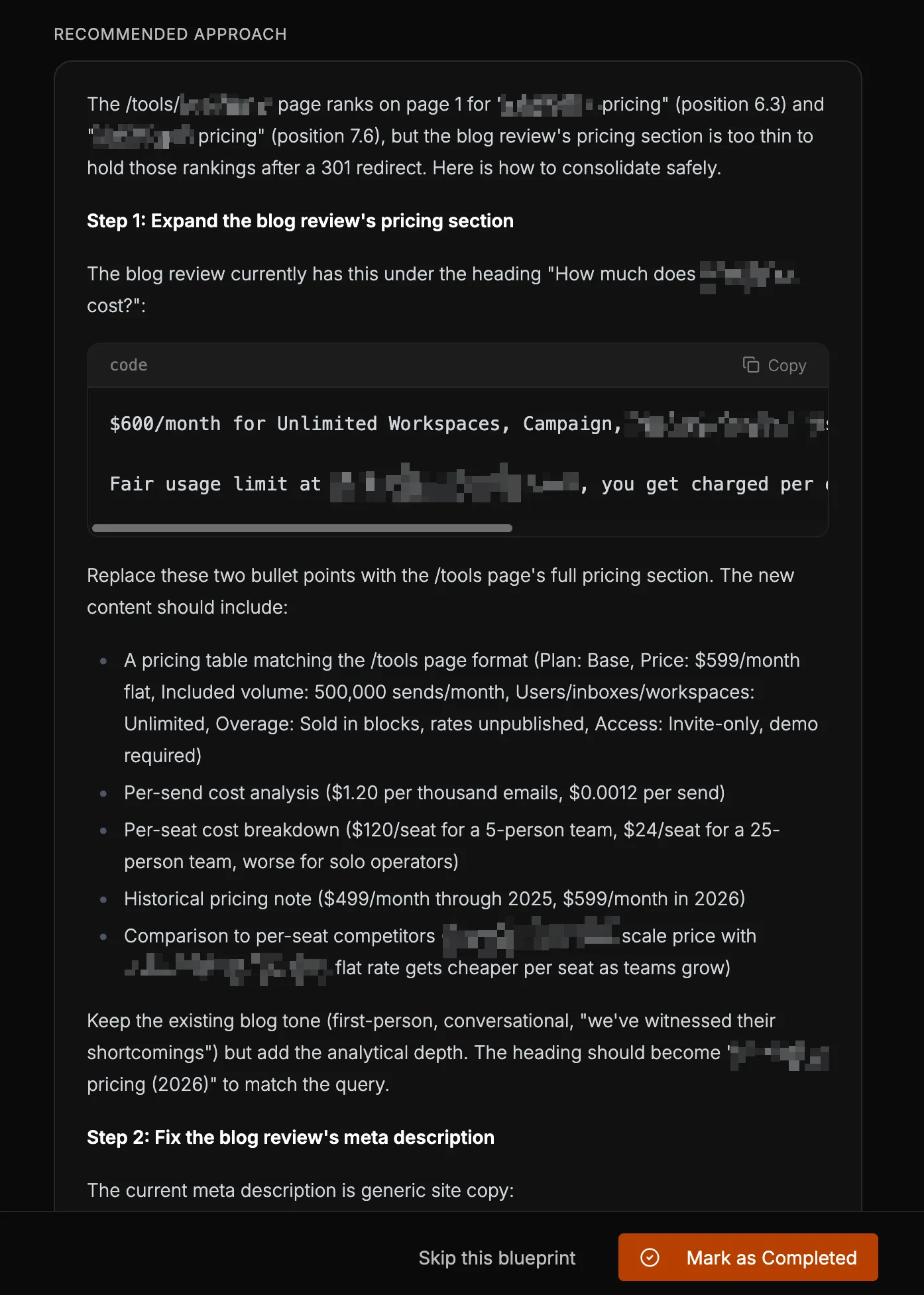
It’s listed last because I wanted you to see what the rest of the SEO world looks like, first. What I’ll say plainly: I’ve spent hundreds of hours and over a thousand dollars of compute on one narrow problem, getting the SEO work actually done without you becoming an SEO.
That’s the whole product, not a feature, not an afterthought. I stand by the comparison above, and you can test it on your own site: your strategy, your topic map, one finished Blueprint and one finished article. No card required, I pick up the compute bill.
Red flags in this route:
-
“Fully autonomous” SEO. Tools that auto-generate, auto-publish, and auto-manage everything with zero input from you are the big one to watch for. They produce AI slop, a tool that writes and posts without asking you anything will produce the same article it would produce for your competitor, and commodity content doesn’t rank sustainably.
-
No understanding of your actual business. If the tool doesn’t learn what your business makes money on and who your customers are, every recommendation is generic by default, because it can’t tell which traffic would even be useful to you.
-
Recommendations with no prioritization. A list of 200 “opportunities” is not a plan. It’s the same shelfware problem wearing an AI label.
Here’s the honest distinction. Done-for-you analysis works, because a machine can dig through your ranking data better than you can. Done-for-you everything doesn’t work, because no one, human or AI, can write about your market, your customers, and your positioning without your input better than you could.
The right question is never how to fully automate big chunks away but which parts of a bigger overarching task to automate and how to keep control of the important decisions.
This route makes sense when: you want done-for-you guidance, you have limited time to manage SEO, and your budget sits in the $100–$200/month range.
Frequently Asked Questions
How much does SEO cost per month for a small business?
Three real numbers. AI consultant tools run about $99/month give or take. Traditional tools like Ahrefs and Semrush run $99 to $449/month, plus twenty to forty hours of your time. Freelancers and agencies run $500 to $5,000+/month, plus five to fifteen hours of management.
Is $500/month enough for SEO?
From a freelancer or agency, $500/month buys the entry tier. You pay enough for them to be reachable for you and get a slot in their retainer list. Maybe Google Business Profile optimization, some directory listings, basic on-page fixes, maybe one piece of content. Real work, but thin, and it won’t move you in a competitive market.
But $500 is a lot of money in the other direction. An AI consultant tool at $99/month can deliver more strategic value than a $500 retainer, provided you or someone on your team implements the recommendations.
Can I just buy Ahrefs or Semrush and do SEO myself?
Yes. Most founders who try this underestimate two things: the 20 to 40 hours a month it takes to run the tool properly, and their own consistency. If you go this route, block the calendar time before you enter your credit card.
What’s the cheapest SEO route that actually works?
Reframe the question. “Cheapest” means best value for your total cost: money plus time. A route you abandon after three months costs you the subscription fee and delivers nothing.
By that measure, most founders get more from an AI consultant tool at $99/month than from a $99/month tool subscription they never open, or a $500/month freelancer doing minimal work. The recommendations get produced either way. The difference is whether they get implemented.
How long does SEO take to show results?
Technical fixes and title/meta tweaks can show movement within days or weeks. Content and authority work takes months, usually three to six before the results are meaningful. That timeline holds regardless of which route you choose, because it’s driven by Google and your competitors, not by your vendor.
What happens if I stop paying for SEO?
Your rankings don’t disappear overnight. They do erode over months as competitors keep publishing and new sites get built, that can sometimes still mean years of traffic. SEO is maintenance, not a one-time purchase, and this applies to every route.
In contrast to an advertisement budget, the ROI does not stop the second you cut the spending.
What to do next
If you want SEO handled without the agency price tag or the DIY learning curve, start with an AI consultant tool. You get a prioritized plan of what to work on next, researched recommendations, and an AI consultant to help you execute. No person to manage. No dashboard to master.
If you outgrow it, add a freelancer for execution. Writing, technical fixes, link outreach. The strategy stays yours, and you’ll brief that freelancer with a clarity most clients never have, because you’ll know exactly what needs doing and why.
Ready to see it? Start your first session with Rank-Hub’s AI consultant. Your strategy, your topic map, one finished Blueprint, and one finished article land in your account, and you judge the recommendations for yourself. The freelancer route would run you several hundred bucks for what you get on the house.