Yes, SEO is worth it for almost every founder. But most fail at it, and the reason is the way they’re told to do it: buy a tool, read generic advice, figure out the rest alone. That approach fails predictably, and I’ll show you exactly why.
Let me guess how you got here. You’ve heard mixed things. Maybe you bought Ahrefs or Semrush, paid for two months, and never logged in. Maybe a freelancer sent you beautiful reports while your traffic flatlined. Sound familiar? That experience is common. It’s also not proof that SEO doesn’t work.
Here’s what I’ll give you instead of a sales pitch. The honest verdict, including who should skip SEO entirely. The real reason founders fail at it. And where you fit, whether you run a small business or you’re weighing agencies against freelancers.
The Honest Verdict: Yes for Most Founders. Here’s Who Should Skip It
Here’s the verdict: SEO is worth it for most founders. The channel works. What fails is execution, and that distinction decides everything that follows.
The pattern is consistent. SEO pays off when you do the right things each week. It fails when you have to reverse-engineer that yourself while also running a company. Most founders get handed a tool like Ahrefs and a pile of generic advice, then left alone. That setup loses every time.
For everyone the verdict applies to, the numbers back the yes. Organic search still drives about a third of all website traffic, even after zero-click results and AI Overviews took their bite (The Digital Bloom, 2025 report). And the top organic result captures somewhere between 28% and 40% of clicks, depending on the study (Backlinko, FirstPageSage). That’s the prize. The question is whether you can actually collect it, and that’s where most founders stumble.
But “most” is not “all.” So here’s the complete go/no-go check: one question and four no-gos. If any of them describe you, SEO is not worth it for you right now.
The One-Question Test
Do you actually need SEO? One question answers that.
Are potential customers searching for solutions to problems you solve? A “yes” means there’s demand to capture. A “no” means you’d be optimizing for an empty room.
Note the wording. Not “searching for what you sell.” People search for problems and solutions, often long before they search for product names or categories. That’s why even a brand-new product can win at SEO: you capture the searches one level up, where the problem is described in general terms, and build demand from there.
You can check this in ten minutes, without paying anyone. Type your product into Google and watch autocomplete finish your sentence. Open “People also ask” and see what real questions come up. Run a few terms through a free keyword tool. That’s it. If the searches exist, the demand exists.
No-Gos
Some situations make SEO the wrong bet right now, no matter how well you’d execute it. Here are the four.
You need revenue in under two to three months. SEO compounds slowly. If the rent is due this quarter, spend your time on outreach, ads, or direct sales instead.
Your offer is purely time-sensitive. Ranking for an event or promotion that expires before you can rank is effort with a built-in expiry date.
You haven’t proven product-market fit yet. If you can’t yet show that people reliably buy what you sell, SEO is premature. Your offer will change, and you’ll be optimizing pages you’re about to delete. Prove the offer first, then build the channel.
You can’t commit 2 to 3 hours a week for six months. Sporadic effort produces nothing in SEO. If your calendar genuinely can’t hold that slot, wait until it can.
If you run a small business, some of these cut differently for you, and a few no-gos actually flip to yes. I’ve written the small-business-specific version separately: is SEO worth it for small businesses.
One Nuance Most Articles Skip
Even in the no-go cases, two things still matter. Your site should be technically sound, and someone searching your brand name should find you. That’s table stakes for credibility, not an SEO program. A prospect who hears about you and Googles you needs to land somewhere real.
So run the test honestly. If you passed, everything that follows applies to you. If you didn’t, you just saved six months and a subscription fee. Either way, you got a straight answer. And if you’re still here, your next question is probably why your last attempt failed. That’s next.
Why You’re Skeptical of SEO (And Why You’re Right to Be)
Your skepticism didn’t come from nowhere. It came from an experience, and I’d bet it looks like one of these.
Maybe it’s the tool subscription. You paid $129 a month, logged in twice, stared at dashboards full of numbers, and closed the tab. The data was there. The decisions weren’t. Nothing moved, and the subscription started gathering dust.
Maybe it’s the agency/freelancer. A retainer, monthly reports, beautiful charts. Traffic flat. Revenue flat. The reports kept coming anyway, because that’s what the retainer was actually paying for.
Or maybe it’s the DIY attempt. You read the guides, started the keyword research, and quit somewhere around week three. Not because you’re lazy. Because “do keyword research” is not an instruction, it’s a homework assignment that’s actually a second job.
Here’s the thing: all three of those experiences are real, and none of them prove SEO doesn’t work. They prove something narrower and more useful. People don’t understand how to actually do SEO to succeed long-term.
Don’t take just my word for it. Search this topic on Reddit and you’ll find founders asking the same question you are: “Is $129 a month for SEO worth it?” Read the replies and a pattern emerges fast. The answers aren’t yes or no. They’re “depends who’s doing it and what you’re getting.” Which is exactly right, and exactly the problem.
The Real Reason Most Founders Fail at SEO
Three failure modes. Nearly every failed SEO attempt fits one of them. Let’s take them one at a time.
Failure Mode 1: You Bought a Tool and Never Used It
You paid for Ahrefs or Semrush. You logged in, saw a dashboard full of numbers, and logged out. Two months later you cancelled. The tool became shelfware. If you’re deciding what to do with that subscription, I’ve written a head-to-head comparison of each tool against Rank-Hub: the Ahrefs alternative, the Semrush alternative, the Moz alternative, and the SearchAtlas alternative.
Here’s why. Tools tell you that something is wrong. Domain authority is low. Backlinks are thin. Topics are not organized in clusters. What they never tell you is what to do Monday morning. Data without a decision attached is just anxiety with a subscription fee.
And that’s not a character flaw on your part. You run a company. You don’t have hours to translate raw metrics into a work plan. Nobody does, unless SEO is their full-time job.
Failure Mode 2: You Hired an Agency and Got Reports
The agency route fails differently. You paid a retainer, and you got exactly what the retainer was priced to deliver: reporting. Monthly PDFs. Traffic charts. Keyword movement tables. Beautiful artifacts.
Here’s why. The retainer covered hours, not outcomes, and hours are easy to fill with activity that looks like progress. You couldn’t tell strategy from reporting until six months in, and by then the money was spent. The agency didn’t lie to you. It just never had to answer the only question that matters: what changed, and why did it matter to your revenue?
Failure Mode 3: You DIY’d It and Drowned
The third failure is the most common. You read the guides. “Do keyword research.” “Build topical authority.” “Optimize your on-page SEO.” All of it technically true. None of it a step-by-step instruction.
Generic advice has no prioritization. It gives you forty possible tasks and no way to know which one matters this week. So you already wear ten hats, and this approach hands you an eleventh. Around week three, something urgent in the business wins and SEO quietly dies.
The Common Thread, and the Fix
Look at the pattern across all three. Tool, agency, DIY. Different surface, same root cause: nobody solved the “what do I specifically do, right now” problem for you. The data existed. The advice existed. The do-this-next plan did not.
That’s the fix, and it’s the standard I’d hold any SEO approach to. SEO works when the prioritization is clear, and when it’s grounded in your actual site data, not generic best practices. Your business (and what makes you money), your Search Console, your rankings, your pages.
Get that, and the channel stops being a bet. It becomes a process.
What SEO Actually Costs (And What You Get for It)
Money is the next question. Always. So here’s the honest map of what SEO costs, path by path, without the sticker-shock games.
Path one: the agency. Expect $1,500 to $10,000+ per month. You’re paying for a team, years of expertise, a process, and someone to answer the phone. At the good end, that’s a real system. At the bad end, you’re buying the monthly PDF from earlier in this article.
Path two: the freelancer. Expect $500 to $2,000 per month. Cheaper, often more hands-on, but quality varies wildly. One freelancer is a specialist who moves rankings. The next is learning on your budget.
Path three: DIY. Cheap in cash. Expensive in time. Tools cost $100 to $200 a month, but the real price is your hours, and your hours are the most expensive resource your company has. Remember failure mode three.
Path four: done-for-you SEO software. From $69 a month, Rank-Hub being the example I know best. It works out what your business actually makes money on and what search demand is worth chasing, then hands you the specific work in order instead of a dashboard to interpret. The thinking of an agency without the retainer, and your hours stay yours. I’m biased here, obviously, so hold it to the same standard as everything else on this page: it has to tell you what to work on this week, from your own data.
One warning before you compare prices. Cheap SEO is usually no SEO. A $300-a-month retainer can’t fund actual work, so it funds reports and technicalities that won’t help you, instead. You’re not saving money. You’re buying the illusion of progress, which is worse than buying nothing, because it costs you six months of belief.
So which price is right for you? That depends on your situation, your market, and what each tier actually delivers. For a full cost breakdown by path and price tier, see the deep dive on how much SEO costs for a small business and what you actually get. It covers every tier, from solo freelancer to premium agency, with a straight answer on where the value cliff sits.
The short version: you can pay in cash, or you can pay in time. What you can’t do is skip the payment and still get results.
Your Four Options at a Glance
By now you know the verdict and the failure modes. Here’s the whole decision compressed into four paths. Each one has a dedicated deep dive if you want it.
The agency. $1,500 to $10,000+ a month. A team, a process, and a retainer. Right choice if the budget exists and you can vet them properly. Wrong choice if you can’t tell strategy from reporting. Start with the SEO agency alternative comparison to see what you should demand for that money.
The freelancer. $500 to $2,000 a month. More hands-on, more variable. The gap between the best and worst freelancer is enormous, so the vetting matters more than the price. The SEO freelancer alternative page breaks down how to tell a specialist from someone learning on your budget.
The marketplace gig. $50 to $300 on Fiverr or Upwork. Cheap, fast, and almost always shallow. Fine for a one-off technical fix, dangerous as a strategy. Both platforms get their own breakdown of where the value cliff sits: the Fiverr SEO and Upwork SEO comparisons.
Done-for-you SEO software. From $69 a month. The prioritization and the thinking of an agency, delivered by software connected to your own data, with your hours left alone. It’s the newest path and the one most of this article points toward. The options inside this path differ a lot too: at one end sits Outrank, which auto-publishes a monthly quota of content on autopilot, and my Outrank comparison covers when that works and when it quietly burns budget.
Notice what all four have in common. The question is never “which is cheapest.” It’s “which one tells you what to work on this week.” That question has a name, and it’s the next section.
How to Make SEO Worth It: The What-to-Do-Next Standard
So you’ve decided SEO is worth it for you. The next question is practical: how do you pick an approach that won’t end up as another cancelled subscription?
Use one filter, and use it on everything. Tools, agencies, platforms, freelancers, all of them. The question: does this tell me exactly what to work on this week, based on my actual data? If the answer is no, walk away. It doesn’t matter how good the dashboard looks or how thick the report is. Without a prioritized, do-this-next answer built from your numbers, you’re back in one of the three failure modes from earlier.
The 5-Point Checklist for SEO Done Properly
Here’s what “done properly” looks like, regardless of who does it. Five points. Check any tool, agency, or service against all of them.
One: prioritized actions, in order. Not a task list of forty items. A short list of what to do next, and what has already been done.
Two: connected to your actual data. Your actual business, your Google Search Console, your pages. Generic best practices don’t count. The plan has to come from your site.
Three: tied to revenue keywords. Rankings for terms nobody buys from are vanity metrics. The work should target searches that lead to customers.
Four: no guaranteed-rankings promises. Nobody can guarantee a position, and Google says so itself. Anyone promising a number one spot is selling you something other than SEO.
Five: progress you can see without reading reports. If you need a monthly PDF to know whether things are moving, the system is built for the report, not for you.
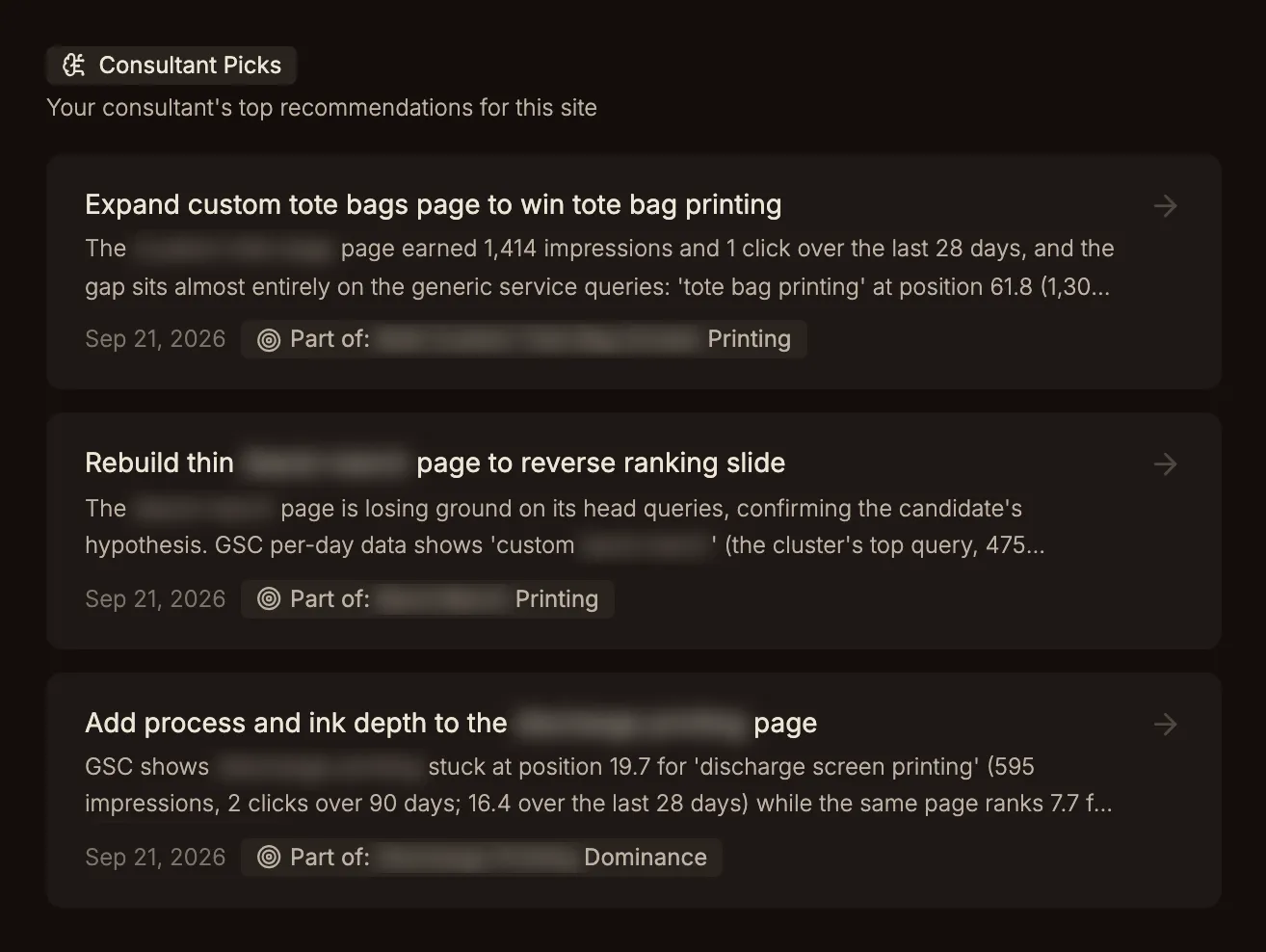
That’s the standard. Hold every option to it, including mine. An approach that passes all five turns SEO from a bet into a process, and a process is what actually gets done.
What the First Six Months Actually Look Like
If you commit to SEO, you should know what the ride feels like. Not the agency brochure version. The real one, month by month for a brand new site.
Months 1 and 2: foundations, not traffic. You fix the technical basics, sort out your site structure, and publish your first pieces of targeted content. Traffic barely moves. That’s normal, and it’s not failure. The data is blunt about why: only 1.74% of newly published pages reach Google’s top 10 within a year (Ahrefs, May 2025). Nobody escapes the ramp-up. What you measure here is whether the work is happening, not whether rankings moved.
Months 3 and 4: first movement. Low-competition terms start budging. Your impressions in Google Search Console climb before your clicks do, because you’re ranking on page two and three first. This is the phase where most founders quit, because the effort is visible and the results aren’t yet. Don’t. Impressions climbing is the leading indicator. It means Google is testing your pages.
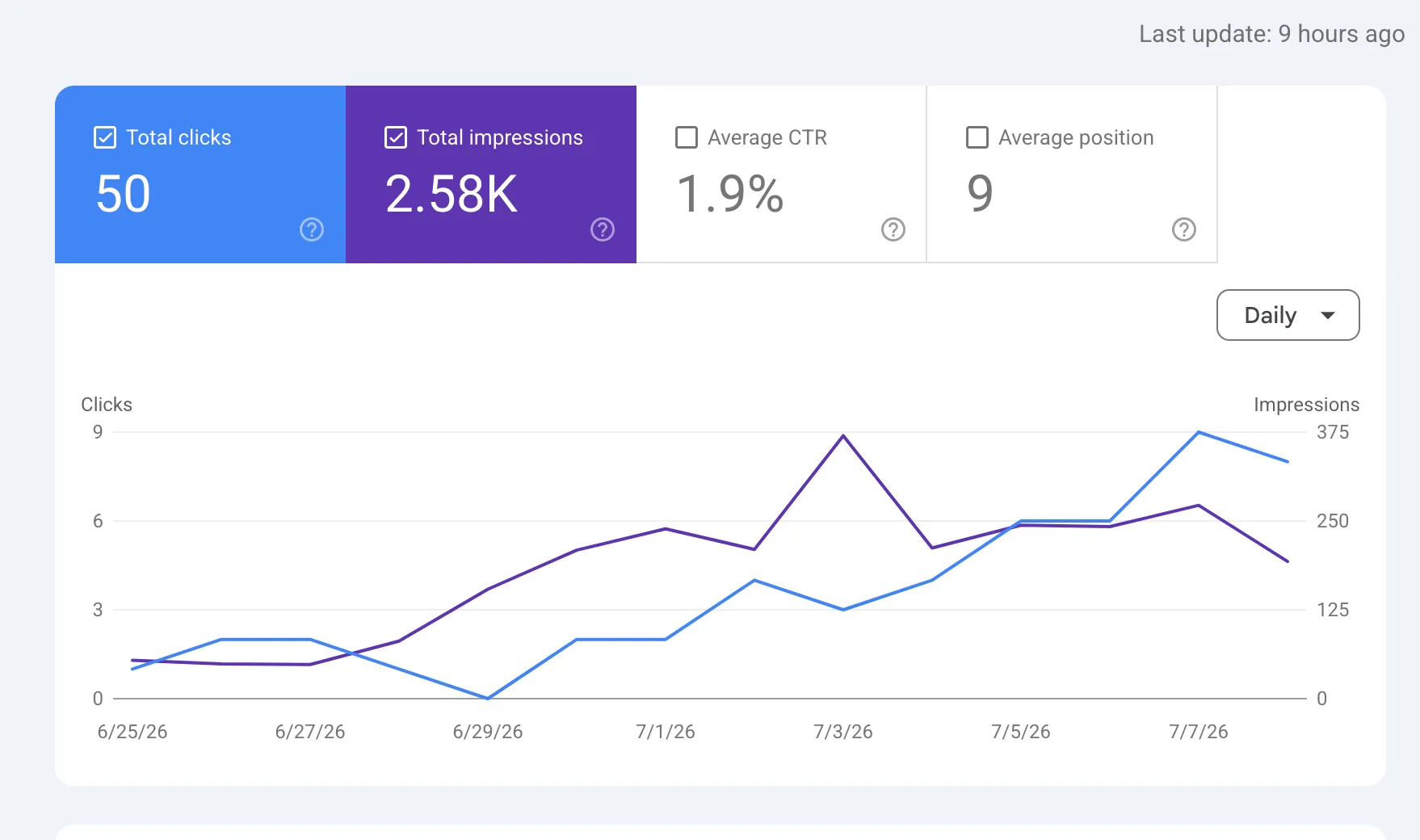
Months 5 and 6: compounding begins. A few pages break onto page one. The early winners pull the rest up with them, through internal links and topical authority. Traffic stops looking flat and starts looking like a curve. And here’s the useful nuance from the same Ahrefs study: of the pages that do reach the top 10, 40.82% got there within a month of ranking at all. When SEO starts working, it often gets picked up consistently for a given site. The slow part is earning the trust through consistent quality and frequency when publishing.
One more number worth knowing before you set expectations. 72.9% of pages in Google’s top 10 are more than three years old, and the average page ranking at number one is five years old (Ahrefs, May 2025). That’s what you’re competing with on big terms, and it’s exactly why the first six months target the small, specific, winnable ones. You don’t fight five-year-old pages head-on. You go around them.
That’s the problem most founders get wrong, and it’s precisely the kind of thing software should be doing for you. When Rank-Hub looks at your site, it starts with the small, specific, winnable terms, not the big ones, so you’re never spending your hours fighting five-year-old pages.
”But AI Is Killing Search, Right?”
AI Overviews answer questions right in Google. ChatGPT and Perplexity answer them without sending anyone anywhere. So why build for search at all?
Here’s the short version: AI answers are built on content that ranks. When ChatGPT cites a source, when Perplexity links one, when an AI Overview quotes one, that source is almost always a page that already ranks well. The AI systems didn’t replace the underlying web. They sit on top of it and pick from it.
Which means good SEO now pays twice. Once in classic blue-link traffic, and once in AI visibility. One effort, two payoffs.
”So Just Get Cited on Reddit Instead”
You’ve probably heard this one too. Forget your own site, the advice goes. Get mentioned on Reddit, because the AI tools love citing it.
Here’s the problem with that plan. Fresh data from PromptWatch (August 2026) suggests Reddit’s share of ChatGPT citations fell from roughly 3.8% to about 0.5% in around a month, an 86% relative drop, after ChatGPT changed how it selects sources on August 8. One platform tweak, and a whole “strategy” collapsed.
To be clear about the limits: the study’s author says the “why” is unproven and a data-collection issue can’t be ruled out, and the study doesn’t measure rankings or traffic. Treat it as early signal, not settled fact. But the signal points at something durable: AI citation sources are volatile. They shift with one algorithm change you don’t control.
Building your visibility on rented, unstable ground is not a strategy. Durable content on your own domain is. That’s the same bet SEO always was, and it’s aged better than the alternatives.
The Verdict: Start Small, Start This Week
So here’s the verdict, in three sentences. SEO is worth it for nearly every founder, and the numbers back that up. What fails is not the channel but the unactionable advice sold as strategy. The fix is having the “what do I work on this week” problem solved for you, from your own data.
Which means the only question left is what you do in the next ten minutes. Not next quarter. Not after you’ve read five more comparisons. This week.
Here’s the smallest possible first step. Give Rank-Hub your domain and you get back your strategy, your topic map, one finished Blueprint, and one finished article for your site: the work consultants typically charge a few hundred for. No card. The compute is on the house.
Then judge the thinking yourself. If the strategy and that first piece of work make sense, you’ve found your process. If they don’t, you’ve spent ten minutes and zero dollars to rule out one more option.