You’ve heard the pitch a hundred times. SEO is the golden ticket to predictable revenue. You’ve also heard the counter-argument: it’s a money pit that lines an agency’s pockets while your phone stays silent.
Both are half-truths sold by people who need you confused.
Here is the honest answer. SEO is absolutely worth it for your small business, but only under specific conditions. You need an offer that already converts. You need real sales proving that your product or service works in the market. Without that foundation, you are just working hard to get traffic that doesn’t translate into money.
Once your business is validated, the game starts to be fun. SEO becomes a multiplier on your existing success, not a lifeline for a sinking ship offer.
Unlike paid ads, where traffic vanishes the instant you stop funding the campaign, organic compounds over time. It systematically lowers your customer acquisition cost and builds a moat your competitors cannot easily replicate.
But you have to ruthlessly ignore most generic SEO advice. Forget the massive checklists and the sprawling content calendars. I’ll show you the few high-impact tasks that actually move the needle. As a fellow small business owner, you simply don’t have the time to do more than necessary.
I have written about whether SEO is worth it more broadly for founders elsewhere (Is SEO Worth It? An Honest Answer for Founders). Here, I want to focus on what is specific to small businesses.
The Brutal Truth: When SEO Is a Waste of Money for Small Businesses
Most guides skip this part. They want you feeling optimistic enough to pull out your credit card, so they conveniently leave out the one prerequisite that determines whether SEO will work for you at all.
Here it is. If your business has zero sales and an unproven offer, SEO is a waste of your money. You cannot optimize your way out of a product nobody wants to buy.
The logic is simple. SEO is a traffic source. It takes whatever your offer already does and puts it in front of more people. If your offer converts at two percent, SEO brings you more of that two percent conversion rate. If your offer converts at zero percent, SEO brings you a larger volume of nothing.
Traffic without conversion is a vanity metric. It looks impressive on a dashboard. It does not pay your bills. One of Rank-Hub’s customers recently reported their monthly quote requests were up 70%, which translates into more money, while I frequently see people talk about traffic alone.
Think about it differently. Would you buy a billboard for a product you have never sold to anyone? Probably not. You would hit the phones, knock on doors, and do whatever direct outreach it takes to prove people will pay for what you built. SEO is no different. It is just a more scalable version of getting attention, and attention without a working offer is just noise.
The “Set It and Forget It” Trap: Why Most Small Businesses See No Results
Many small business owners treat SEO like a home renovation. You hire someone, they do the work, and you move on. That mindset guarantees wasted budget.
Search engines do not reward static websites. Google constantly re-evaluates your site, looking for signs that your business is active and relevant. Stop updating, and the algorithm assumes you have gone stale.
Your competitors are not standing still either. They are publishing new pages, optimizing existing ones, and building authority every single month. If you do nothing, you are not holding your position. You are moving backward.
Content also decays. A page that ranked well a year ago loses ground as search intent shifts or newer information appears elsewhere. Refreshing those pages signals to Google that your content still deserves attention.
This ongoing type of work is exactly why DIY efforts often fizzle out. A founder starts with good intentions, spends a weekend optimizing a few pages, then gets pulled back into running the business. A month later, the work stops. The rankings never arrive.
The 80/20 for SEO that actually matters for SMB
Most SEO guides hand you a checklist of two hundred tasks and call it a strategy. For a founder already wearing ten hats, that checklist guarantees failure and inconsistency. You will never get through it. You will feel overwhelmed, stop, and conclude SEO does not work.
You do not need a massive blog. You do not need a complex backlink strategy. You do not need a perfect technical score. You need the handful of high-impact tasks that actually move revenue. Everything else is noise designed to keep agencies billing for busywork.
SEO helps your business when it captures demand that already exists. People searching for what you sell right now. The question is whether you show up when they do.
Start by identifying the handful of queries your buyers use when they are ready to purchase. Not broad research queries. Not informational browsing. The specific phrases someone types when they have a problem and are looking for a solution to buy.
The hard part is knowing which queries those are. Most founders guess. The ones who get it right use their existing search data instead. Google Search Console is the gold standard to get that data, if your page already has some search impressions.
Map each group of queries with the same intent to a dedicated page on your site. If someone searches “best project management tool for small teams,” you need a page that speaks directly to that need. Not a generic homepage. Not a blog post about productivity trends. A focused page that matches the buyer’s language and answers their question.
This turns SEO traffic into leads. You are not creating demand. You are positioning yourself in front of existing demand.
But here is where blanket advice hits its limit. The specific queries that matter and what content to produce to rank for it depend entirely on your business, your market, and what your existing data shows. A generic list of “best SEO keywords” is useless.
You need your own data, and you need a way to turn it into clear priorities instead of a spreadsheet you have to learn to interpret.
Realistic Timelines: When You Will Actually See Results
SEO compounds slowly, but it is not a black box that stays dark for two months. Both versions get sold, and both are wrong. For a small business with some existing search presence, here is what to expect:
Weeks 1 to 3: Individual changes can already move. Rewrite a weak title, fix a meta description, make a page actually answer what people are searching for. Google re-crawls, and the effect often shows up in Search Console within one to three weeks. No single change is guaranteed to land, and the numbers are small in absolute terms. But you are not flying blind for two months waiting to find out whether any of this works.
Weeks 4 to 16: The wins start stacking. New and refined pages collect impressions. Some crack page 2 or 3 on lower-competition queries. Clicks show up on more than one page instead of one lucky fix. This is also where most of your competitors quit, because any individual week can look flat or negative. The barrier is not skill, it is outlasting everyone who stopped at week six.
Weeks 17 to 50: Momentum. If you have been consistent, pages climb onto page 1 for realistic queries. Traffic becomes meaningful rather than measurable. You can attribute leads or sales to organic search.
All of this assumes you are working on the right things. Three months of busywork produce nothing no matter how disciplined you are about it. The variable that decides your timeline is not effort, it is whether the pages you touch were the ones worth touching.
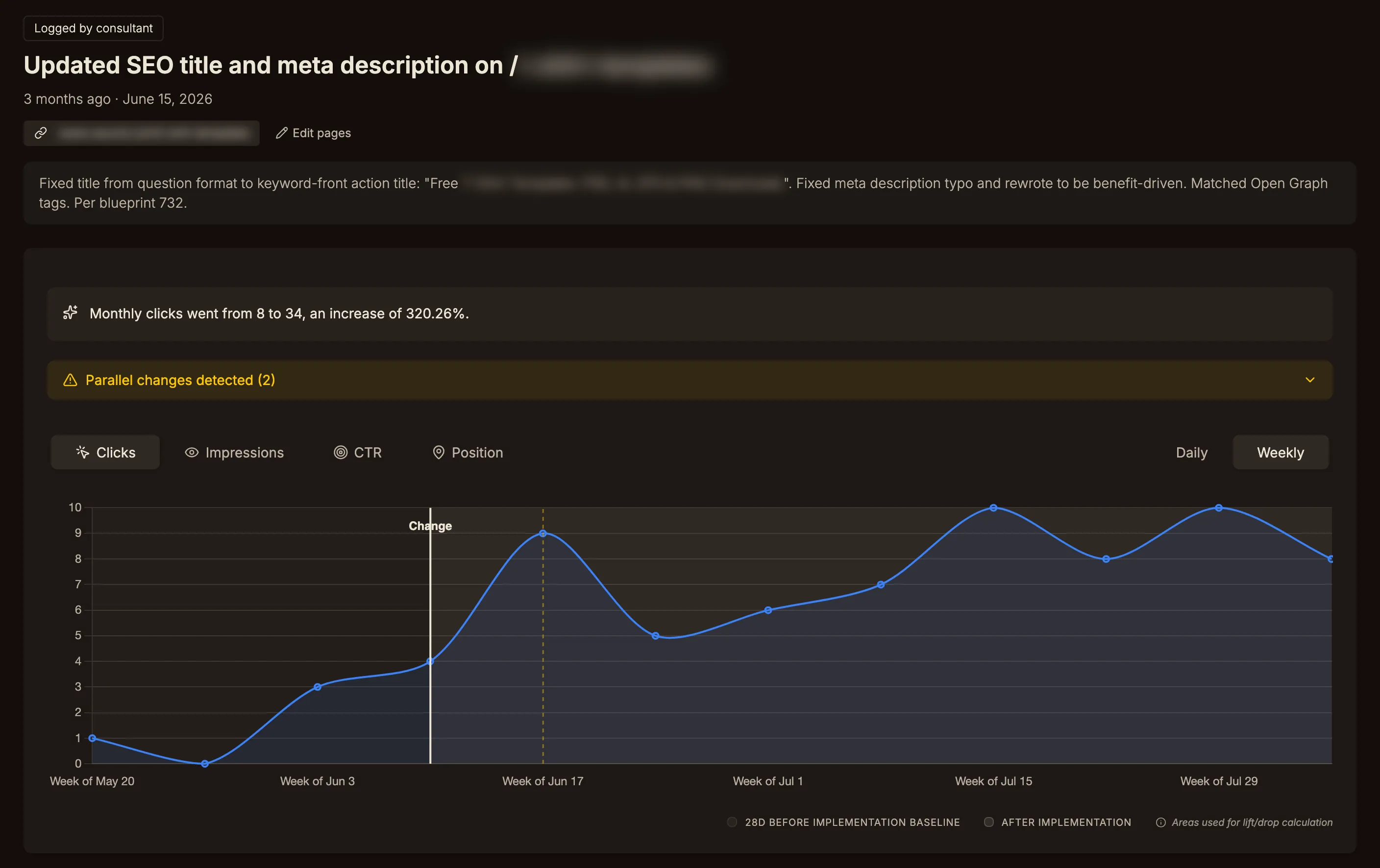
That first phase is not theoretical. The chart above is a single page after a title and meta description rewrite. Weekly clicks roughly doubled within a week of the change, then fell back to a value between the old baseline and that first spike. From there they settled at around two to three times where they started, and monthly clicks went from 8 to 34.
Notice the shape, though. It wobbles every week, and the last week drops back down near the old level. That is not the change failing. At these volumes a few clicks either way is a normal week, and real traffic curves are jagged, especially at low numbers. Judge a change by where the line sits a month later, not by its best or worst single week.
How to Get SEO Done Without Wasting Your Limited Time
Knowing what to do is only half the battle. You still have to find the time to actually do it. Even a stripped-down SEO strategy demands consistent weekly effort, and a founder already wearing ten hats rarely has hours to spare.
Many founders look to hire help. That is where most small business owners get burned.
Agencies can produce real results for companies with dedicated marketing teams and budgets to match. For a founder managing everything solo, the model breaks down. You pay for overhead, account managers, and reporting decks before any actual optimization happens. The agency model has trade-offs worth understanding before you sign a retainer.
Freelancers are more affordable and can be genuinely good if you find a good one who stays committed long-term. The problem is that they can easily get booked out by bigger budgets or stop their freelancing career altogether. Managing them is real work too. You need to understand and sign off on their strategy, review the work, and catch quality issues before they compound. Marketplaces like Upwork and cheap gigs on Fiverr have their own specific limitations that are easy to miss when you are focused on price. A $50 deliverable is not a system. It is a checkbox that produces no lasting results.
The common thread is not that these options are bad. It is that they all have tradeoffs, that you can better balance out with big budgets that SMBs usually don’t have. If you want the dollar amounts side by side, I wrote the full breakdown of what SEO costs for a small business, from $500 retainers to $99 tools.
The Expert Tool Trap: Ahrefs, Semrush, Moz…
There is an elephant in the room. Before you considered hiring an agency or a freelancer, you probably tried an SEO tool. Something like Ahrefs, Semrush, or Moz. You paid for a subscription, logged in a few times, stared at the dashboards, and closed the tab. The newer AI platforms don’t escape the trap either. SearchAtlas and its OTTO assistant still hand you a console of toolkits, credits, and quotas to drive. Outrank removes the console by removing you: it auto-publishes a monthly quota of articles on autopilot, and whether that trade is a win is exactly what my Outrank alternative page works through.
You are not alone. Most founders who buy these tools barely use them. Not because the tools are bad. They are excellent at what they do. The problem is what they do because of who they are made for.
Open Ahrefs as a founder and the dashboard greets you with a thousand keywords, each labeled with something like “Keyword Difficulty 74.” Somewhere in the corner it says “300 issues found on your page.”
All accurate.
None of it tells you what to do first, what to write, or whether any of it is worth your evening. Before the tool pays off, you invest hours learning what DR, UR, and difficulty scores even mean. Then you spend more hours each week interpreting which of those 300 flagged issues actually matter.
The real cost is the hours you lose learning what every metric means, interpreting which issues matter, and trying to turn raw data into a plan you can actually execute. Hours taken from the business you are actually qualified to run. That is how a good tool actively hurts you if it was never made for you. It creates the illusion of progress without anything getting published or optimized.
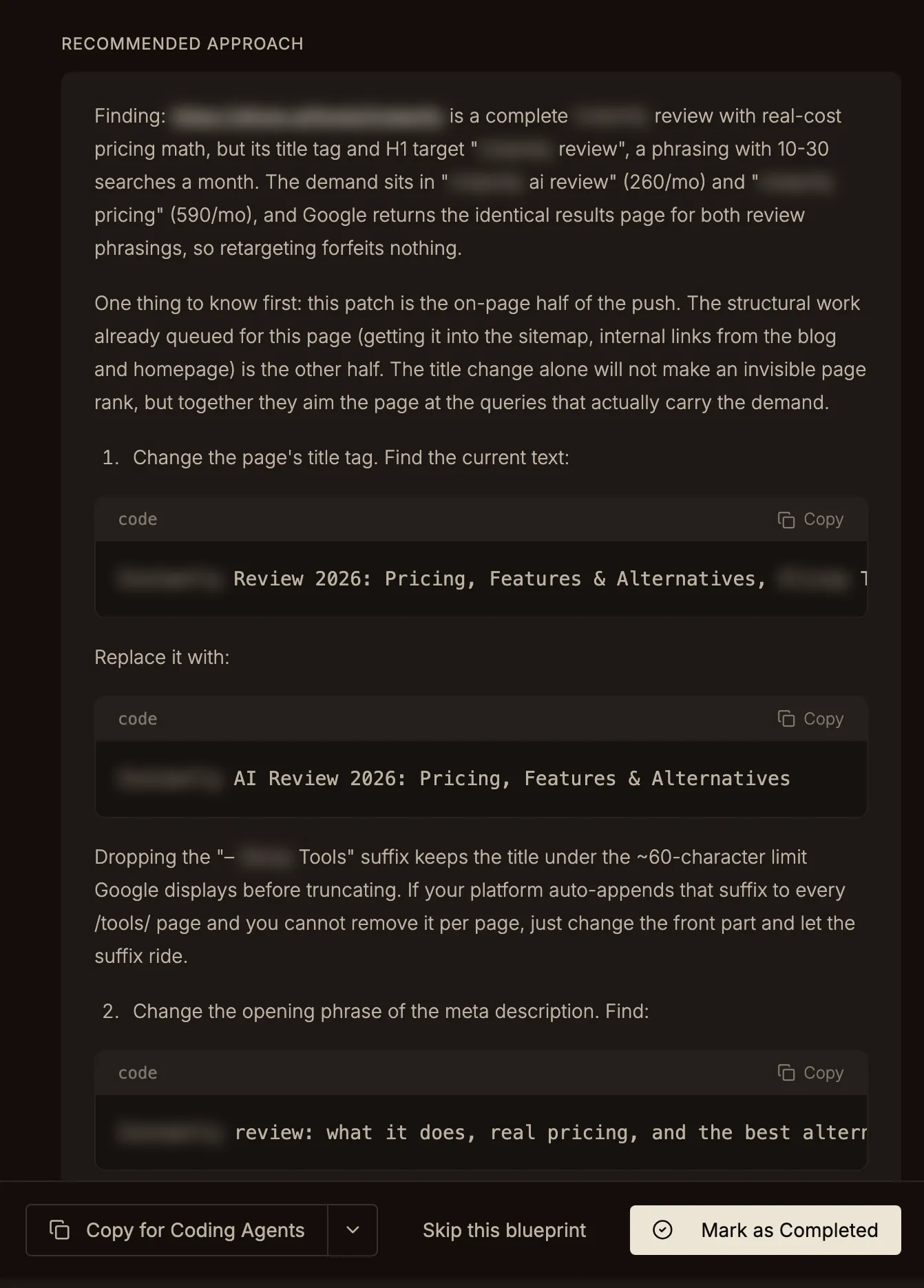
Rank-Hub is not another tool in that category. It reads your site, the live search results and your own search data the way an SEO expert would, and tells you exactly what to fix or publish today. Not a dashboard to interpret, but tailor-made for founders doing their own SEO. You stay involved because your expertise is what makes results stick. But the analysis, the prioritization, the strategy, the legwork. Here’s an excerpt from a real blueprint:
Conclusion: Stop Guessing, Start Growing
SEO is worth it for your small business under two conditions. You need an offer that already converts, and you need to focus exclusively on the tasks that move revenue. Everything else is a distraction designed to keep you paying for busywork.
Do not try to do everything. The businesses that win at SEO are the ones that work on the right, high-impact things week after week.
Rank-Hub has a free trial. Let it identify exactly what you need to work on. You can get your strategy drafted for free by signing up. See how straightforward SEO becomes when a system tells you precisely what to do.